
Illustrated recipe
Crisp Pork with Sweet-and-Sour Sauce
This home version uses a shallow layer of oil. The pork cooks in small batches and is quickly coated in sweet-and-sour sauce.

What you need
Tick off each ingredient as you set it out. The steps tell you when to taste a cooked dish and how to adjust the flavour.
How big is a teaspoon or tablespoon?
1 tsp is a 5 mL measuring spoon. 1 US tbsp is 15 mL, or 3 tsp. For flour or sugar, sweep the top level with the back of a knife.
Set these out first
You need a knife, board, two bowls, heavy frying pan, a second small pan, long chopsticks, long tongs, spatula and a metal lid that covers the frying pan. Use the chopsticks only for raw pork and the tongs only for cooked pork. If oil catches fire, turn off the stove and cover it. Never add water.
How high should I turn the heat?
Use only about 1 cm / ⅜ in oil and keep it below one-third of the pan depth. Start around setting 6. Lower one small drop of the pork coating into the oil. When fine bubbles appear immediately without the coating darkening at once, test one pork slice. If the oil smokes, turn off the stove and let the pan cool before continuing.
5 steps with pictures
-
 AI illustration
Step 01
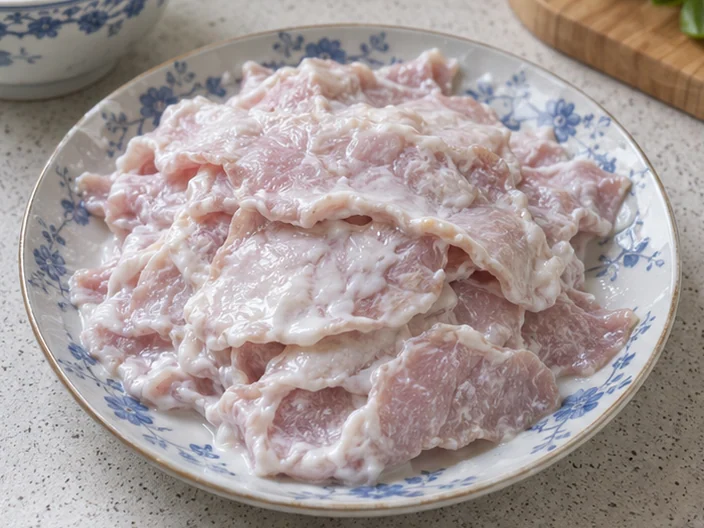
Cover both sides of each pork slice with a thin starch coating
- First cut the carrot, scallion and ginger into thin strips on a clean board and put them on a small plate. In a separate bowl mix 25 mL vinegar, 25 g sugar and the soy sauce, reserving the remaining vinegar and sugar for the final adjustment.
- Put the potato starch in a bowl and add water gradually until it looks like thick yoghurt.
- Pat the pork dry and add it to the starch mixture.
- Turn each slice until both sides are covered and no bare pink patches show.
- Wash your hands and any surface that touched raw pork. Do not use the coating left in the raw-pork bowl for the sauce or for tasting.
Cook from this stepHow to tell you’re readyThe starch coating stays on a lifted slice and only drips slowly.
-
 AI illustration
Step 02
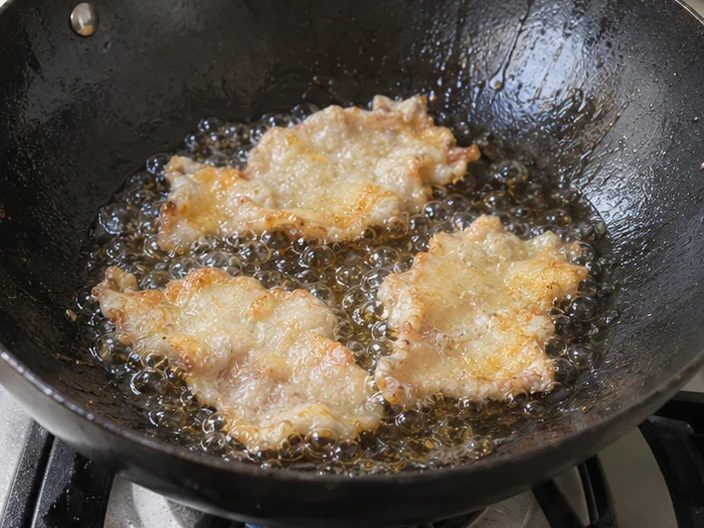
Shallow-fry the pork in batches
- Make sure the pan is completely dry. Add about 1 cm oil, keep the metal lid nearby and start around setting 6.
- Test with one small drop of coating. When fine bubbles appear immediately and it does not darken at once, lift one pork slice with the long chopsticks reserved for raw pork, let excess coating drip back, then lower it close to the oil. Remove cooked pieces only with the separate clean tongs.
- Cook only 3–4 pieces at a time without touching. Fry about 2 minutes per side and remove when pale gold.
- After the first batch, cut open the thickest slice. If the centre and juices show no pink, put it on a clean plate and rest for 3 minutes. If pink remains, return it to the pan for 30 seconds per side and check again. Repeat with each batch.
Cook from this stepHow to tell you’re readyThe shell is pale gold and firm, and the thickest slice has no pink meat when cut.
-
 AI illustration
Step 03
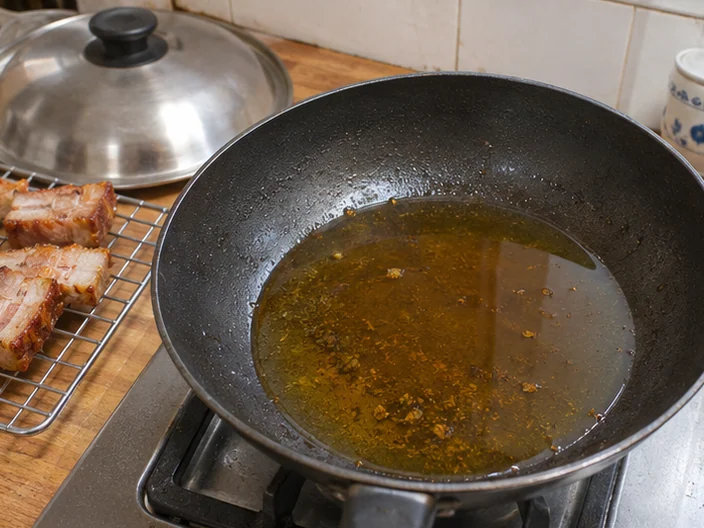
Turn off the stove and leave the frying oil to cool in place
- After removing all pork, turn off the stove. Leave the frying pan where it is on the stable burner until fully cool; do not carry hot oil.
- Only when completely cool, strain the oil into a lidded container for another frying use, or seal it in a container and discard it as local waste rules direct. Do not pour it down the sink.
Cook from this stepHow to tell you’re readyThe stove is off, the hot oil pan remains where it was and the area is free of water and clutter.
-
 AI illustration
Step 04
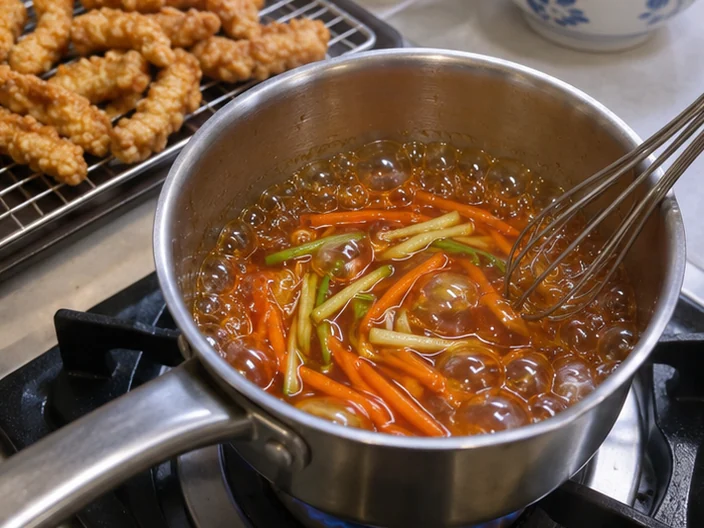
Cook the sweet-and-sour sauce in a separate small pan
- Put the reserved 1 tsp fresh oil in a second small pan and add the carrot, scallion and ginger.
- Use setting 4 under the small pan and cook for 30 seconds.
- Pour in the sweet-and-sour mixture and cook for 20–30 seconds after large bubbles appear, then turn off the stove. Cool a clean spoonful and taste. Add ½ tsp sugar if too sour or ½ tsp vinegar if too sweet. Bring it back to a bubble and taste once more.
Cook from this stepHow to tell you’re readyThe sugar has dissolved, the sauce is slightly sticky and the vegetable strips keep their colour.
- AI illustration
Step 05
Coat quickly and serve at once
- Once the sweet-and-sour balance tastes right, return the small pan to the heat. As soon as large bubbles return, add the cooked pork.
- Turn the pieces from underneath two or three times so both sides get sauce.
- Turn off the stove within 30 seconds and transfer immediately to a dry plate.
Cook from this stepHow to tell you’re readyA thin glossy sauce covers the pork and the edges still look crisp.
The coating separated into water on top and a firm starch layer below. What should I do?
Do not add the pork yet. Pour off a little clearly excess water, then slowly loosen the starch from the bottom with chopsticks. Add only 1 teaspoon water if it becomes too dry.
Coat the pork when the mixture is one thick, slow-flowing batter that falls from the chopsticks without separating again.
See the picture in step 1Several coated slices are stuck together before frying. How do I separate them?
Hold them over the batter bowl and ease them apart from the edges with chopsticks. Dab a little batter over any bare patch, then lay each slice separately on the plate.
Fry one at a time only when every slice lifts independently and no coated edges join the next slice. Do not lower a clump into the oil.
See the picture in step 2My sweet-and-sour sauce is forming sticky threads. Can I loosen it?
Turn off the heat and leave the pan in place. Keep your hands clear and wait until the pan and syrup have cooled completely. Add a tablespoon of warm water, then reheat gently and stir.
Once the sauce runs off the back of the spoon, turn off the heat, toss the pork in it briefly and serve. If the syrup is black and bitter, make a fresh batch.
See the picture in step 4The pork softened as soon as I added the sauce. Can it become crisp again?
Stop tossing and spread the pork on a wide plate. Keep the remaining sauce in a separate bowl instead of pouring it over.
A softened shell will not fully return to its fresh-fried crunch. Serve once it has stopped soaking up more sauce; do not cook it longer.
See the picture in step 5More help by step
- Step 1 · Cover both sides of each pork slice with a thin starch coating
- Add starch if the coating runs off like water, or 1 tsp water if it forms dry clumps.
- Step 2 · Shallow-fry the pork in batches
- Lower one setting if the coating darkens fast. If the test coating does not bubble, wait a little longer. If the oil smokes, turn off the stove and let it cool before continuing.
- Step 3 · Turn off the stove and leave the frying oil to cool in place
- Ask anyone nearby to keep clear. Do not carry the hot oil, add water or seal it with a tight lid.
- Step 4 · Cook the sweet-and-sour sauce in a separate small pan
- If the sauce becomes syrupy, turn off the stove and stir in 1 tbsp water.
- Step 5 · Coat quickly and serve at once
- If the pork softens, stop turning and serve immediately. Keep extra sauce separate rather than pouring it all over.
Kitchen notes
Ask about a step or share how it turned out. Your comment will be public.
Loading comments…