
Illustrated recipe
Guizhou Potato Cakes
Yangyu means potato. Mash the cooked potatoes, pat them into little rounds and give each one time to develop a crust before turning.

What you need
Tick off each ingredient as you set it out. The steps tell you when to taste a cooked dish and how to adjust the flavour.
How big is a teaspoon or tablespoon?
1 tsp is a 5 mL measuring spoon. 1 US tbsp is 15 mL, or 3 tsp. For flour or sugar, sweep the top level with the back of a knife.
Set these out first
Have a saucepan, a skillet, a fork, a spatula, a slotted spoon and a mixing bowl ready.
How high should I turn the heat?
For frying, keep a gas flame under the skillet or start at 4 on a 1–9 stove. The cakes should sizzle gently without smoke.
4 steps with pictures
-
 AI illustration
Step 01
Cut and boil the potatoes
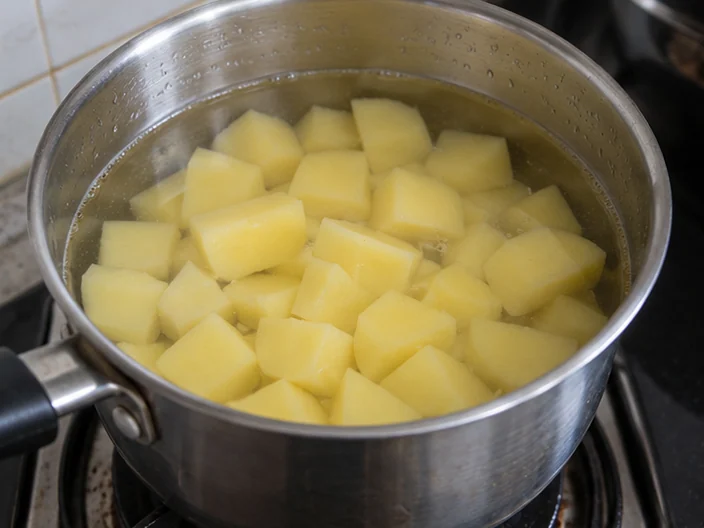
- Wash and peel the potatoes. Halve them and set the flat sides on the board.
- Cut into 2 cm (¾ in) chunks and place in a saucepan. Add cold water to cover by about a finger’s width.
- Bring to a boil, then turn down until the water bubbles gently. After 12–18 minutes test one of the largest pieces.
Cook from this stepHow to tell you’re readyA fork slides into the centre and a little pressure splits the chunk.
-
 AI illustration
Step 02
Drain thoroughly and mash
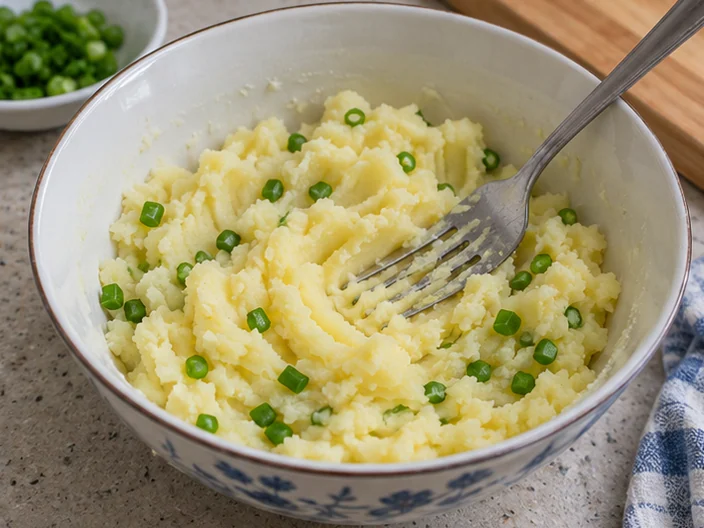
- Lift the pieces into a bowl. Tip out any water that collects and let steam escape for 2–3 minutes.
- Mash the warm potatoes with the back of a fork until no hard lumps remain. Reserve a spoonful of plain mash, then stir the scallions and half the salt into the rest.
- Cool a little mash on a spoon and taste. If bland, mix in a small pinch of salt and taste again. If salty, fold in the reserved plain mash. Once you like the flavour, mix in the cornstarch and let the mash cool enough to shape.
Cook from this stepHow to tell you’re readyA little mash holds its shape when you open your hand, with no dry starch showing. You can mix in any unused plain mash too.
-
 AI illustration
Step 03
Shape six cakes and brown the first side
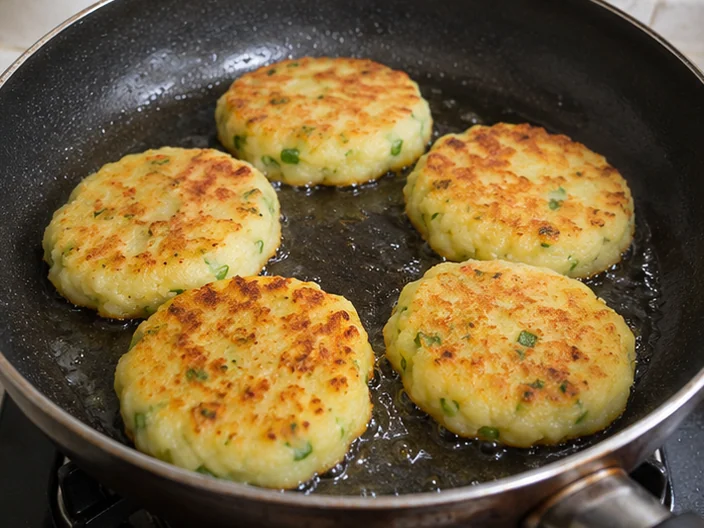
- Divide into six. Take a few drops from the frying oil and rub a very thin film over your palms. Roll and flatten each portion to about 1.5 cm (½ in) thick, with no water droplets left on the surface.
- Spread a little oil in a skillet. Test it with a crumb of potato. When it sizzles gently, add the cakes with space between them.
- Leave them alone for about 3–5 minutes. Ease the spatula under a cake and look for a golden edge before turning.
Cook from this stepHow to tell you’re readyThe spatula lifts the whole cake and the underside has a golden crust.
- AI illustration
Step 04
Brown the second side and serve
- Slide the spatula at least halfway under each cake, lift a little and turn it over.
- Give the second side another 2–4 minutes. Lift an edge to check and turn off the stove when both sides are golden.
- Set the cakes on the plate in a single layer. For a second batch, add the remaining oil and repeat.
Cook from this stepHow to tell you’re readyThere is a thin crust outside and soft potato inside.
The mash is too wet and sticky to shape. What should I do?
Spread it on a wide plate for 5 minutes so steam escapes. If it still slumps, mix in starch 1 teaspoon at a time and test a small ball.
Stop adding starch when the ball holds in your palm with no white dry powder showing. Too much will make the centre firm.
See the picture in step 2The cake cracks when touched and the bottom is still stuck. What should I do?
Leave it alone for another 30 seconds. Then keep the spatula flat against the pan and work slowly from the edge to the centre. If it still resists, wait another 30 seconds.
Turn it only when the spatula supports the whole cake and a crust has formed underneath. A small cracked edge needs no repair.
See the picture in step 3The outside is very dark but the centre is too soft to lift. Should I keep frying?
Lower the stove, support it underneath, give the second side 30 more seconds, then rest it on a plate for 2 minutes. Do not keep flipping it.
It is ready when it can be lifted whole after resting and the centre remains soft potato. A black, bitter edge cannot be restored, so trim it away.
See the picture in step 4More help by step
- Step 1 · Cut and boil the potatoes
- If the centre resists the fork, cook for 2 more minutes and test again.
- Step 2 · Drain thoroughly and mash
- If it feels wet and sticky, spread it out and let more steam escape before shaping.
- Step 3 · Shape six cakes and brown the first side
- If the cake pulls apart, stop and give it another half-minute. Cook in batches if the pan is small.
- Step 4 · Brown the second side and serve
- A cracked edge is fine. Support it from underneath with the spatula when you serve it.
Kitchen notes
Ask about a step or share how it turned out. Your comment will be public.
Loading comments…