
Illustrated recipe
Sweet-and-Sour Whole Carp
This home version uses a shallow layer of oil. The whole fish is pan-cooked, then covered with sweet-and-sour sauce. Use fish steaks if your pan is not wide enough.
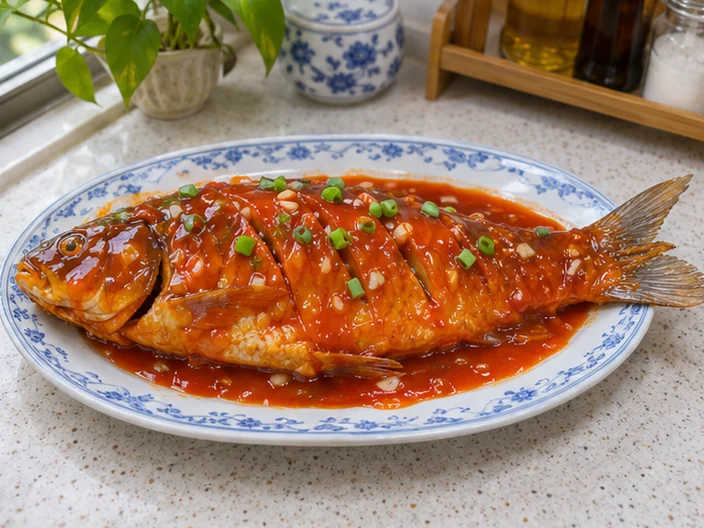
What you need
Tick off each ingredient as you set it out. The steps tell you when to taste a cooked dish and how to adjust the flavour.
How big is a teaspoon or tablespoon?
1 tsp is a 5 mL measuring spoon. 1 US tbsp is 15 mL, or 3 tsp. For flour or sugar, sweep the top level with the back of a knife.
Set these out first
Set out a wide frying pan and a second clean pan with a lid, large enough to hold the fish flat. You’ll also need a long spatula, tongs, a small saucepan for the sauce and paper towels. Ask the fish counter to scale and gut the fish and remove the gills.
How high should I turn the heat?
Start the gas knob halfway up, or an electric stove at 5 out of 9. Listen for a gentle sizzle and watch the skin turn golden gradually. Lower the heat if it darkens quickly. If the oil smokes, turn off the burner and leave the pan in place to cool.
5 steps with pictures
-
 AI illustration
Step 01
Dry the fish and mix the sauce
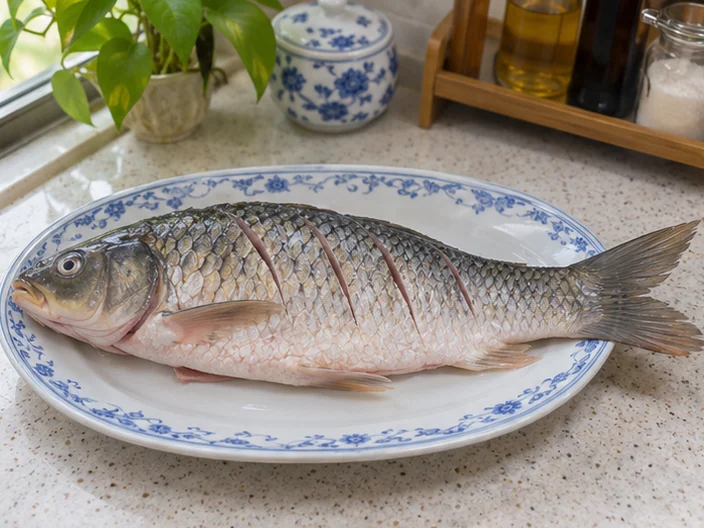
- Check that the scales, gills, and insides are removed. Do not rinse the fish; pat the inside and outside dry with paper towels.
- Make three shallow cuts across the thick part on each side. Cut into the flesh without cutting through the backbone.
- Mix the ketchup, vinegar, sugar and soy sauce with 100 mL of water until the sugar mostly dissolves. Keep the remaining 30 mL of water for cooking the fish.
- Pat a thin layer of cornstarch over both sides and into the cuts. Shake off loose flour.
Cook from this stepHow to tell you’re readyThe fish looks dry with a thin white coating and no thick clumps.
-
 AI illustration
Step 02
Brown both sides of the fish
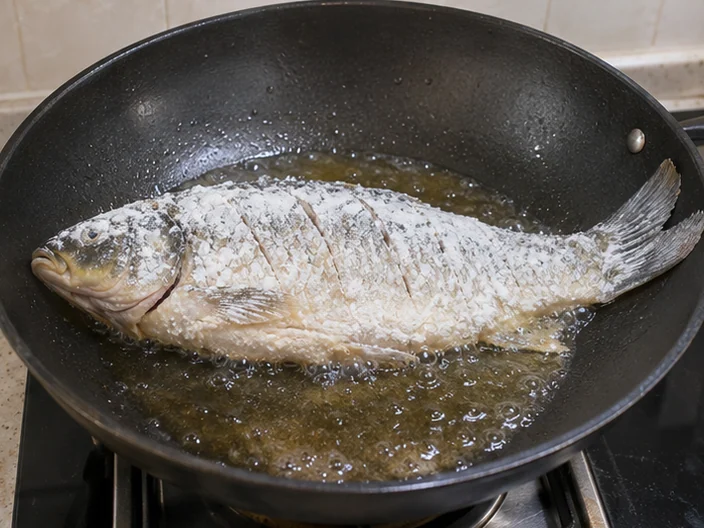
- Set a wide frying pan on the stove, add 45 mL / 3 US tbsp oil, then turn on the heat. Start gas halfway between low and high or electric at 5 out of 9.
- Drop in a pinch of cornstarch. When it bubbles at once, support the fish with the long spatula, steady the tail with tongs, and lower it slowly away from your body. Keep your hands away from the hot oil.
- Leave it alone for 4 minutes. When it releases with a gentle push and the bottom is golden, turn it slowly using both the spatula and tongs.
- Cook the second side for about 4 minutes, lowering the heat if it darkens quickly. When both sides are golden, turn off the stove. Use the spatula and tongs to lift the fish into the second clean, unheated pan. Leave the frying pan and its oil in place until completely cool.
Cook from this stepHow to tell you’re readyBoth sides have a golden crust and most of the skin remains on the fish.
-
 AI illustration
Step 03
Cover, cook and check the thickest part
- Add 30 mL (2 US tablespoons) of water to the second pan holding the fish. Cover, then turn on the heat and keep it low enough for small bubbles at the edge. Leave the frying pan and its oil alone.
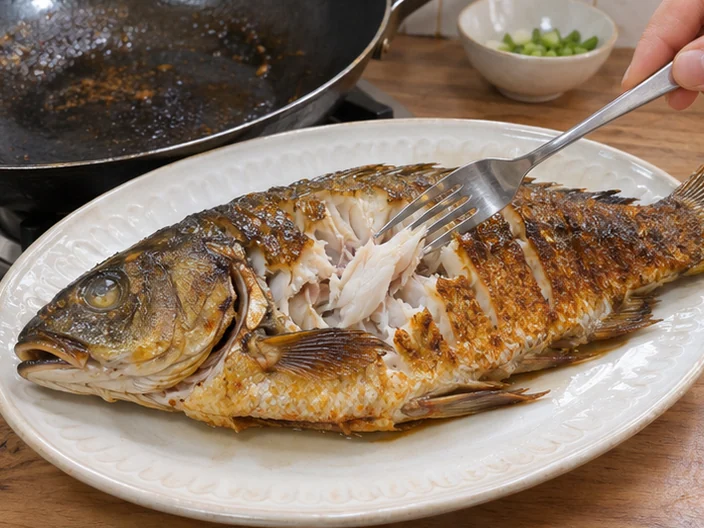
- Cook covered for 5 minutes. Use a clean fork to open the thickest flesh along the back. Move the fish to the plate only when the inside has changed from translucent to opaque and separates into flakes.
Cook from this stepHow to tell you’re readyThe thickest part is white throughout, flakes along its natural lines and has no translucent flesh.
-
 AI illustration
Step 04
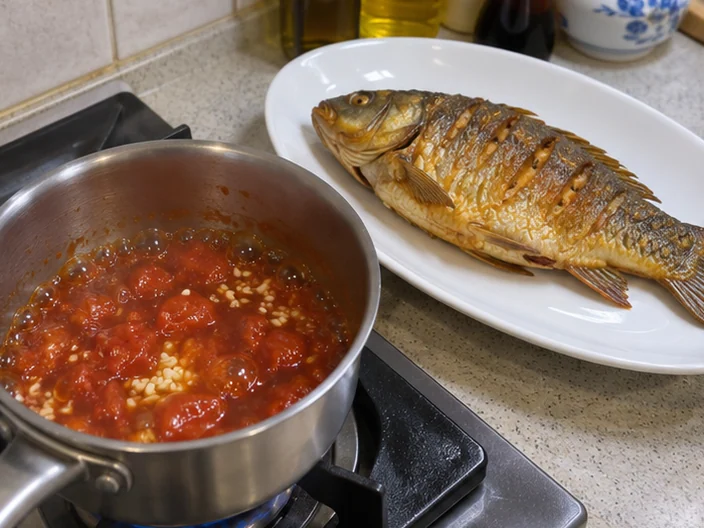
Move the fish out, then cook the sweet-and-sour sauce
- Move the fish to a large plate using the spatula and tongs. In a small saucepan, heat 5 mL / 1 US tsp oil with the scallion, ginger, and garlic for about 30 seconds over low heat.
- Pour in the mixed sauce. Once the whole surface bubbles, cook for 1 minute while stirring gently. Cool and taste a clean spoonful. If too sour, add ½ teaspoon sugar. If too sweet, add ½ teaspoon vinegar. If salty, add 2 tablespoons water. Stir and taste after each change.
Cook from this stepHow to tell you’re readyThe aromatics are not burnt and the bubbling sauce is slightly thicker with a balanced sweet-and-sour taste.
- AI illustration
Step 05
Spoon the sauce over the fish
- Check that both burners are off.
- Spoon the hot sauce slowly over the fish from head to tail.
- Open the thickest flesh near the back with a clean fork and confirm there is no translucent raw flesh before serving.
Cook from this stepHow to tell you’re readyThe whole fish is golden under a glossy red sauce, and the thickest flesh is fully opaque.
The skin is stuck and the fish starts tearing when I move it. What should I do?
Do not scrape or force the turn. Leave it in place for another 30 seconds, then slide a wide spatula slowly along the bottom. Wait another 30 seconds if it still holds fast.
Turn only when the spatula can support the fish without pulling off more skin. Torn skin will not stick back on, so serve the intact side facing up.
See the picture in step 2The sauce tastes sharply sour before I pour it on the fish. How do I balance it?
Keep the fish on its plate. Cool a spoonful of the separately boiled sauce and taste it. If it’s too sour, stir half a teaspoon of sugar into the pan until it dissolves.
Cool another spoonful on a clean spoon and taste again. Pour it over the fish when you can still taste the vinegar without that sharp pucker.
See the picture in step 4The sweet-and-sour sauce is thin and watery and will not cling to the fish. What should I do?
Keep the fish on its plate rather than soaking it. Let the sauce bubble on its own and stir every 10–15 seconds. Lift a spoonful and watch how it runs from the back of the spoon.
Turn off the heat when a thin glossy film remains on the spoon instead of running off like water. Cooking until sticky will hide the crisp surface of the fish.
See the picture in step 4More help by step
- Step 1 · Dry the fish and mix the sauce
- If the fish does not lie flat in the pan, do not bend it. Use fish steaks and judge the cooking by the thickest piece.
- Step 2 · Brown both sides of the fish
- If it sticks, do not force it. Wait 30 seconds and try again. If the oil spits hard, lower the heat and keep your face and body away.
- Step 3 · Cover, cook and check the thickest part
- If the thickest part is still translucent, return the fish, cover and cook 2 minutes more, then check another thick area.
- Step 4 · Move the fish out, then cook the sweet-and-sour sauce
- If the sauce smokes or the pan blackens, turn off the heat and use a clean saucepan. Adjust with ½ teaspoon sugar, ½ teaspoon vinegar or 2 tablespoons water, returning it to a bubble before tasting.
- Step 5 · Spoon the sauce over the fish
- If you find translucent flesh, return the fish to the second pan used to simmer it. Add two tablespoons of water, cover and keep small bubbles at the edge. After two minutes, check the thick part again with a clean fork.
Kitchen notes
Ask about a step or share how it turned out. Your comment will be public.
Loading comments…