
Illustrated recipe
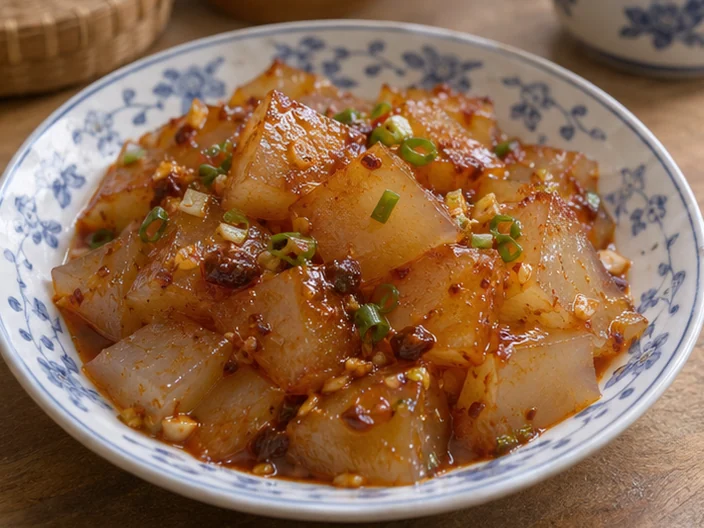
Kaifeng Pan-Fried Starch Jelly
Kaifeng cooks starch jelly with fermented bean paste, scallion, and garlic until hot and silky. Local versions often use fermented watermelon-and-soybean paste. This accessible home version uses common yellow soybean paste, so its flavour will differ, and starts with firm store-bought jelly.
What you need
Tick off each ingredient as you set it out. The steps tell you when to taste a cooked dish and how to adjust the flavour.
How big is a teaspoon or tablespoon?
1 tsp is a 5 mL measuring spoon. 1 US tbsp is 15 mL, or 3 tsp. For flour or sugar, sweep the top level with the back of a knife.
Set these out first
You need a non-stick frying pan, spatula, knife, board, and small bowl. Buy intact, properly chilled, ready-made starch jelly firm enough to cut. Do not rinse it.
How high should I turn the heat?
The jelly should sizzle gently and develop pale golden patches. Lower the heat at once if it darkens quickly or the bean paste starts burning.
5 steps with pictures
-
 AI illustration
Step 01
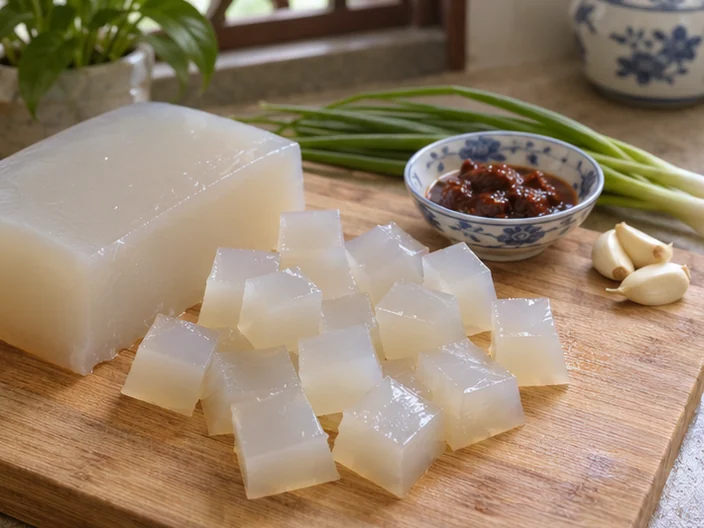
Cut the jelly into sturdy cubes
- Open the jelly and check that it smells mild, with no sour or spoiled odour. Gently blot the surface with a clean paper towel.
- Cut the jelly into cubes about 2 cm / ¾ inch wide. Very small pieces break easily, while slightly uneven pieces are fine.
Cook from this stepHow to tell you’re readyThe jelly cubes lift in one piece on a hand or spatula, with clean cut sides rather than crumbling immediately.
-
 AI illustration
Step 02
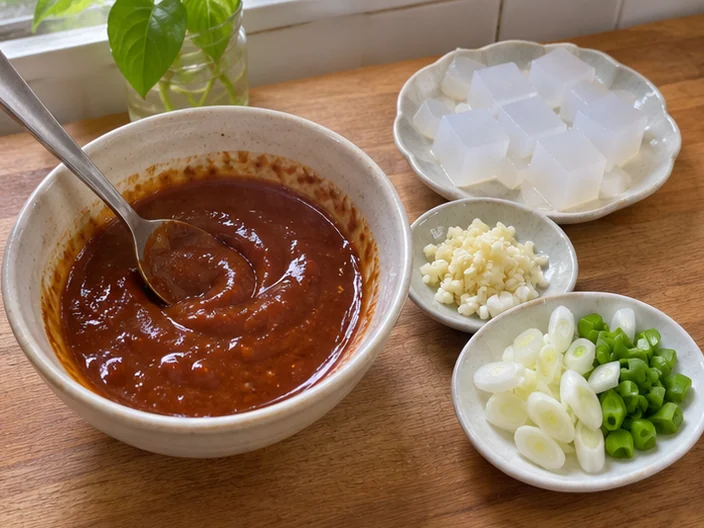
Mix the bean sauce and separate the aromatics
- Mix the soybean paste, soy sauce, water, and chilli until no large lumps remain.
- Chop the garlic and scallions. Divide the garlic in two, then keep the white and green scallion parts separate.
- Taste a little sauce with a clean spoon. If the soybean paste is already very salty, do not add more soy sauce.
Cook from this stepHow to tell you’re readyThe sauce is evenly brown with no firm lumps, and the scallion whites, greens and two portions of garlic are kept separate.
-
 AI illustration
Step 03
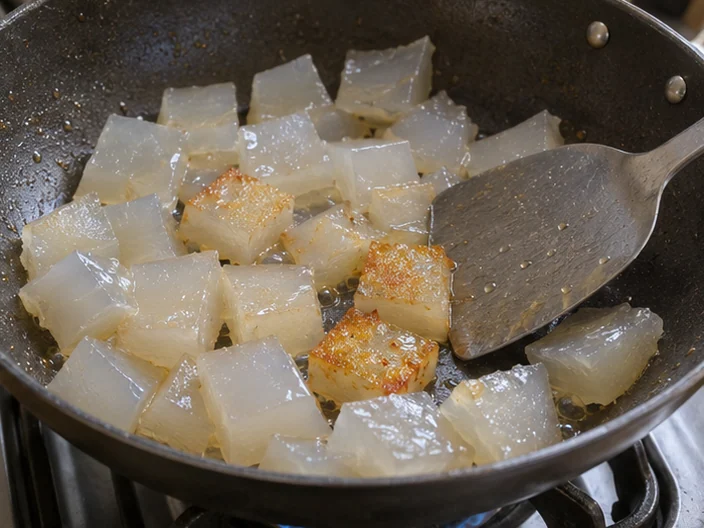
Give the jelly pale golden patches
- Set a non-stick pan securely, add the oil, then turn on the heat. Start with a short gas flame under the centre of the pan, or use 4 out of 9 on electric.
- Add the jelly in as close to one layer as possible. Once it sizzles gently, leave it for 2 minutes without turning.
- Slide the spatula along the pan. When the pieces release and have pale golden spots underneath, turn them gently a few times.
- Cook for about 2 minutes more. Push the pieces to the side when their edges become more translucent.
Cook from this stepHow to tell you’re readySome undersides have pale golden patches, while the cubes remain mostly whole with more translucent edges.
-
 AI illustration
Step 04
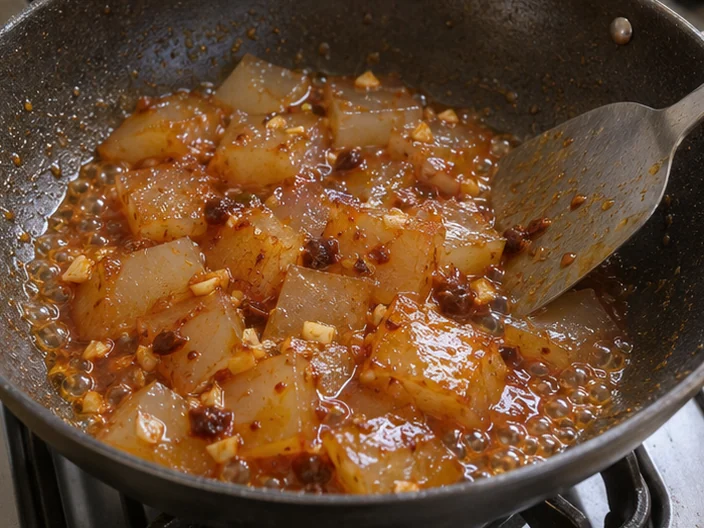
Add the bean sauce and let it bubble gently
- Add the scallion whites and half the garlic to the open centre of the pan. Move them for about 20 seconds, stopping when they smell fragrant.
- Stir the sauce again and pour it in. Turn the jelly gently from underneath two or three times to coat it.
- When the whole pan bubbles, reduce to a short gas flame or 2–3 out of 9 on electric. Bubble gently for 3 minutes.
- Cool and taste a clean spoonful of sauce. Add 2 tablespoons water if salty, ½ teaspoon soy sauce if bland, or ½ teaspoon soybean paste if the fermented flavour is weak. Let it return to a bubble before tasting again.
Cook from this stepHow to tell you’re readyThe jelly is hot and translucent, coated in a thin reddish-brown sauce with only a little liquid left in the pan.
- AI illustration
Step 05
Finish with garlic and scallion
- Choose the largest cube and cut through its centre with the spatula. When the cut face is translucent and gives off heat, turn the stove completely off.
- Scatter in the reserved garlic and scallion greens, then gently rock the pan.
- Lift the jelly from underneath into a shallow bowl and spoon over the remaining sauce.
- Taste one piece. If the raw garlic is too sharp, toss it through the hot jelly a few more times. Serve with plain steamed bread or rice if it is too salty.
Cook from this stepHow to tell you’re readyThe jelly is soft but still cubed, with brown-red sauce, green scallion, and fine garlic on top.
The scallion and garlic scorched before the sauce went in. What now?
Turn off the stove and leave the original pan on a stable burner until completely cool. Do not carry the pan or pour hot oil. Once cool, lift out jelly without a burnt smell. Use a separate clean, dry pan with a little fresh oil, adding spare aromatics if available or the mixed sauce directly.
Water will not hide burnt bitterness. Return the jelly only when the fresh sauce has no burnt smell or black specks. Leave out any pieces that already taste bitter.
See the picture in step 3The jelly released a lot of water and the sauce will not cling. What should I do?
Leave the pan uncovered at small bubbles. Stop turning the jelly and gently rock the pan instead. Check every 30 seconds until the liquid changes from watery to a light coating.
Do not keep fully hot jelly cooking for a long reduction. Stop when only a thin layer remains and rocking the pan draws brown sauce over the cubes.
See the picture in step 4The raw garlic added at the end is painfully sharp. How can I soften it?
Add no more garlic. While the pan is still warm, cover it for 1 minute, then uncover and rock gently. Remove some visible garlic if it is still overpowering.
Serve when the garlic smells aromatic rather than harsh. Garlic already absorbed cannot be removed completely, so pair the dish with plain mantou or rice.
See the picture in step 5More help by step
- Step 1 · Cut the jelly into sturdy cubes
- If the jelly crumbles, cut larger 3 cm / 1¼-inch pieces and move them less later. Discard any product with a spoiled smell or swollen package.
- Step 2 · Mix the bean sauce and separate the aromatics
- If the sauce is too salty, stir in 1 tablespoon water and taste again. Press any firm paste against the side of the bowl to smooth it out.
- Step 3 · Give the jelly pale golden patches
- If it sticks, wait 30 seconds rather than scraping hard. If it darkens quickly, turn off the stove and move the pan to an unlit burner. When the sizzling quiets, continue over a shorter flame or lower setting. Do not add water while hot oil is still in the pan.
- Step 4 · Add the bean sauce and let it bubble gently
- After the sauce is in the pan and there is no layer of hot oil, add 2 tablespoons water around the edge if the sauce is drying before the jelly is hot. Cover and let it bubble gently for 1 minute. Broken pieces are fine; rock the pan instead of stirring further.
- Step 5 · Finish with garlic and scallion
- Scoop up broken pieces with the sauce; the flavour is unchanged. If leftovers firm up, return them to the pan with 1 tablespoon water, cover, and reheat over a short gas flame or electric setting 2 until soft.
Kitchen notes
Ask about a step or share how it turned out. Your comment will be public.
Loading comments…