
Illustrated recipe
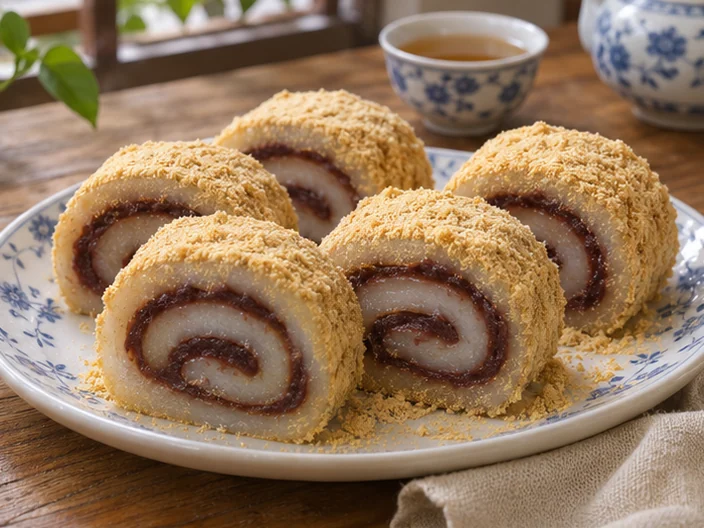
Beijing Glutinous Rice Rolls with Red Bean Paste
Also called doumian gao, these soft glutinous rice rolls are filled with red bean paste and coated in roasted soybean flour. This home version starts with packaged roasted soybean flour, so there is no need to toast raw soy flour.
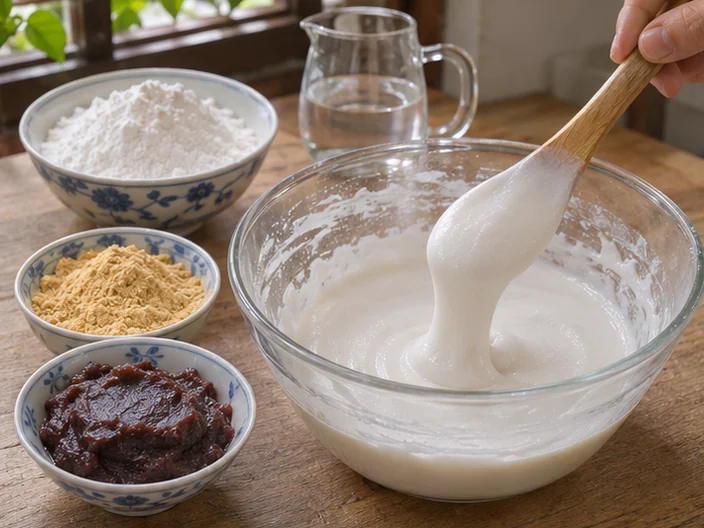
What you need
Tick off each ingredient as you set it out. The steps tell you when to taste a cooked dish and how to adjust the flavour.
How big is a teaspoon or tablespoon?
1 tsp is a 5 mL measuring spoon. 1 US tbsp is 15 mL, or 3 tsp. For flour or sugar, sweep the top level with the back of a knife.
Set these out first
You need a steamer, shallow heatproof dish, mixing bowl, silicone spatula, rolling pin, knife, and board. The soybean flour must be labelled roasted, cooked, or ready to eat.
How high should I turn the heat?
Keep enough steam rising to cook the rice mixture, without letting the water touch the dish. Keep a gas flame under the base of the pan. On a 1–9 electric stove, start around 6 and reduce to 4 or 5 once the water boils.
6 steps with pictures
-
 AI illustration
Step 01
Mix a smooth rice-flour batter
- Taste a little ready-to-eat bean paste with a clean spoon. If it is sweet enough for you, put just the rice flour in the bowl. If you would like the wrapper a little sweeter, mix the sugar into the flour.
- Add the water in two or three batches, scraping the bottom and sides after each addition.
- Keep mixing until there are no dry patches or firm lumps. The batter should fall from the spatula in a slow, thick ribbon.
- Lightly oil a shallow heatproof dish. Pour in the batter and gently level it.
Cook from this stepHow to tell you’re readyThe batter is smooth and slowly pourable, with no dry flour at the bottom.
-
 AI illustration
Step 02
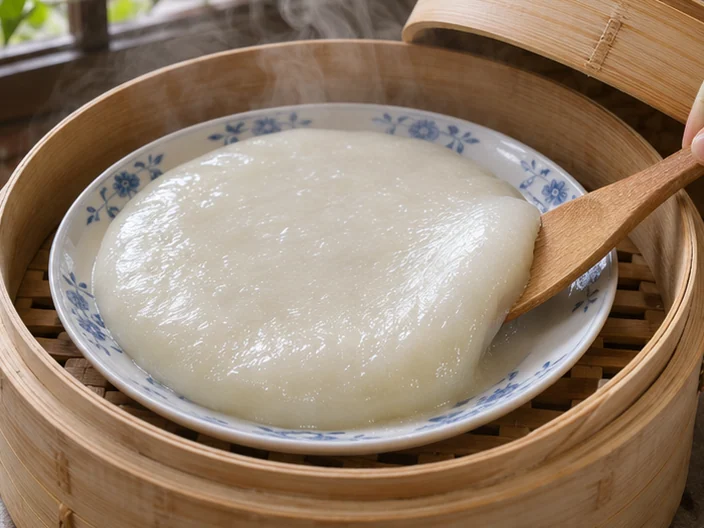
Steam until the centre is cooked
- Add water below the steamer rack. Cover and heat until a steady stream of steam appears.
- Set the dish on the rack and cover. Keep a gas flame under the pan or use 4–5 out of 9 on electric. Steam for 20 minutes.
- Turn off the stove and let the steam settle for 30 seconds. Lift the lid away from you, then use a chopstick to open a small spot in the centre.
- The centre is ready when it looks pearly, glossy, and sticky rather than like wet white flour. Remove the dish and let it cool until safe to handle. Do not taste undercooked batter.
Cook from this stepHow to tell you’re readyThe rice cake looks glossy and moist, with no white paste in the centre.
-
 AI illustration
Step 03
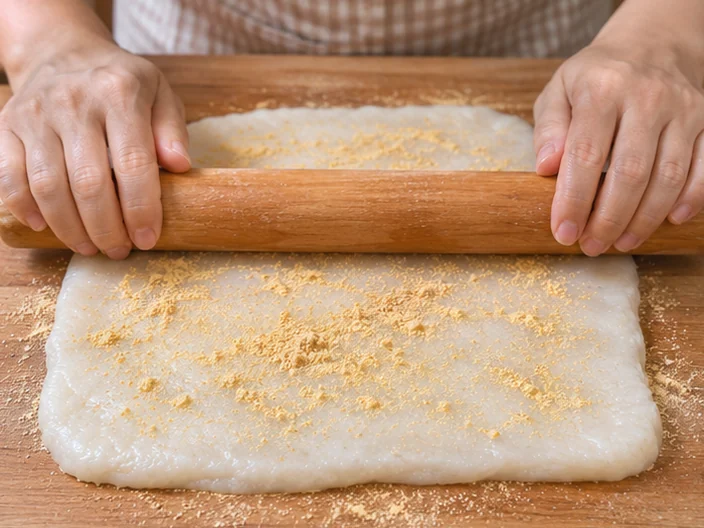
Dust and roll out the rice cake
- Spread half the roasted soybean flour over a clean board, covering an area slightly larger than the rice cake.
- When the rice cake is warm but safe to touch, loosen it with the spatula and place it on the flour. Dust more flour over the top.
- Dust the rolling pin and gently work from the centre outward into a rectangle about 5 mm / ¼ inch thick. Add a little flour only where it sticks.
Cook from this stepHow to tell you’re readyThe rice layer is fairly even, with no thick lumps at the corners, and one edge lifts from the board on the spatula.
-
 AI illustration
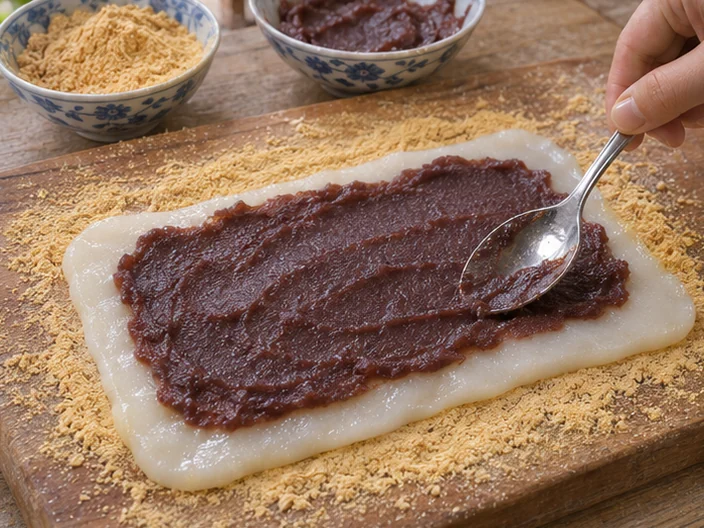
Step 04
Spread a thin layer of bean paste
- Stir the bean paste until smooth. If it is too stiff to spread, mix in 1 teaspoon water.
- Dot the bean paste over the rice sheet in small spoonfuls. Use the back of a damp spoon to spread it slowly from the centre out.
- Leave a 1 cm / ½-inch bare border around the sheet and avoid pressing the spoon into the rice layer.
Cook from this stepHow to tell you’re readyA thin, even layer of bean paste covers most of the rice sheet, with a narrow white border still visible.
-
 AI illustration
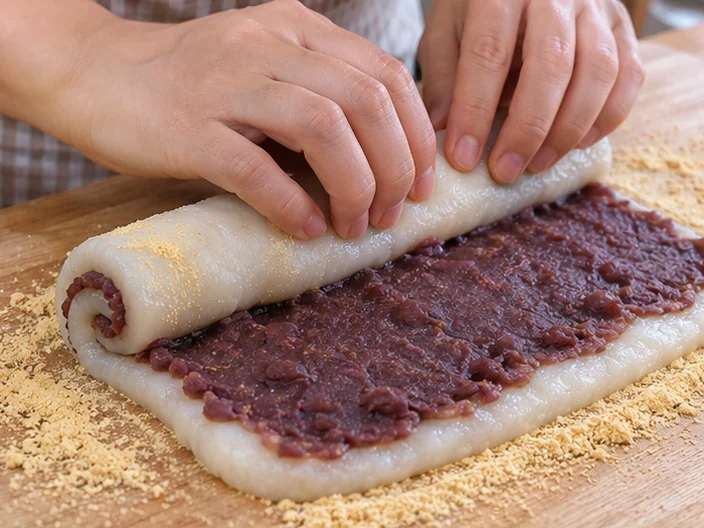
Step 05
Roll from a short edge into a firm log
- Starting at a short edge, fold over about 2 cm / ¾ inch, then lift and roll with both hands. Press gently after each turn to reduce gaps.
- Place the seam underneath and roll the outside in a light coating of roasted soybean flour.
Cook from this stepHow to tell you’re readyThe log is fairly even from end to end, with the seam underneath, and it stays rolled when you remove your hands.
- AI illustration
Step 06
Slice and serve
- Dust both sides of the knife. Trim the uneven ends, then cut into pieces about 3 cm / 1¼ inches wide, wiping the blade every two or three cuts.
- Serve straight away. Do not leave leftovers sitting out. Put them in a covered container and refrigerate promptly; the rice layer will firm up in the fridge. Cut smaller pieces for anyone who has difficulty swallowing.
Cook from this stepHow to tell you’re readyEach piece has a pale golden coating and a clear spiral of white rice cake and red bean paste.
The rice cake is stuck to the steaming dish. How do I lift it out?
Loosen all around the rim, then slide a thin silicone spatula along the base a little at a time. Dust each newly exposed section underneath with roasted soybean flour.
Do not pull hard on one corner. Start rolling when the spatula can support the whole sheet and no broad patch remains on the dish.
See the picture in step 3I used too much soybean flour and the sheet tastes dusty. What can I do?
Lift the rice sheet slightly and tap off loose flour. Brush loose flour from the top with a dry pastry brush or clean fingers. Do not add water because it will form lumps.
Spread the bean paste when only a thin coating remains and flour no longer falls off at a touch. Leave the small amount already stuck to the sheet.
See the picture in step 3Bean paste is squeezing out of the front and sides as I roll. What should I do?
Stop and scrape any paste beyond the bare border back into the bowl. Fold the unrolled sides slightly inward, then continue with lighter pressure.
The escaped filling will not pull itself back in. Finish when a bare strip of rice sheet can seal the edge and the next turn does not push out more filling.
See the picture in step 5More help by step
- Step 1 · Mix a smooth rice-flour batter
- If it is too stiff to stir, add water 1 teaspoon at a time. If it pours like milk, mix in 1 tablespoon glutinous rice flour and check again.
- Step 2 · Steam until the centre is cooked
- If the centre still looks like white paste, cover and steam for 3 more minutes, then check a different spot. Add hot water around the side first if the steamer is running dry.
- Step 3 · Dust and roll out the rice cake
- If it sticks to the rolling pin, do not pull. Add a pinch of roasted soybean flour and loosen it from below with the spatula. Pinch a small tear closed and gently flatten it.
- Step 4 · Spread a thin layer of bean paste
- If the rice sheet shifts, stop and dampen the spoon before spreading more gently. Pinch a small tear closed and avoid rubbing over it again.
- Step 5 · Roll from a short edge into a firm log
- If the first turn is loose, pause and gently draw the rolled part towards you with both hands before continuing. Do not stretch the whole sheet.
- Step 6 · Slice and serve
- If a piece flattens under the knife, gently round the sides with your fingers. Small gaps in the spiral are fine; do not unroll the whole log.
Kitchen notes
Ask about a step or share how it turned out. Your comment will be public.
Loading comments…